BPC-157 in Peptide Research: Experimental Insights into Cytoprotection and Tissue Repair Signaling
Introduction
BPC-157 is a synthetic peptide fragment derived from a sequence originally identified within a larger gastric protein. Over the past two decades, it has become a frequently studied compound in preclinical research focused on cellular repair mechanisms, cytoprotection, and tissue integrity under stress conditions.
Unlike classical growth factors or anabolic signaling agents, BPC-157 is of research interest due to its broad modulatory effects across multiple biological systems, despite its relatively short amino acid sequence. Experimental models suggest that BPC-157 does not act through a single dominant pathway, but rather influences a network of signaling processes involved in maintaining cellular structure, vascular stability, and adaptive repair responses.
This article examines BPC-157 strictly as a research compound, summarising its structural characteristics, proposed mechanisms of action, and relevance within laboratory and animal research models.
Molecular Origin and Structure
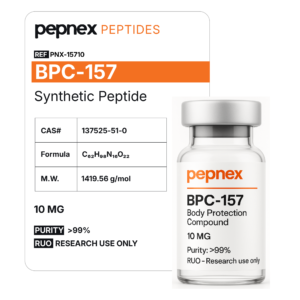
BPC-157 (Body Protection Compound-157) is a pentadecapeptide, consisting of 15 amino acids. The sequence is derived from a region of a naturally occurring gastric protein believed to play a role in maintaining gastrointestinal integrity.
Key structural characteristics include:
- Short linear peptide chain
- High stability in simulated gastric environments (in experimental models)
- Resistance to rapid enzymatic degradation compared to many endogenous peptides
These properties make BPC-157 a practical subject for laboratory research, as it maintains structural integrity under conditions that would rapidly degrade less stable peptide sequences.
Research Interest in Cytoprotection
One of the defining themes in BPC-157 research is cytoprotection—the study of mechanisms by which cells preserve structural and functional integrity when exposed to stressors.
In preclinical models, BPC-157 has been investigated for its interaction with:
- Cellular membrane stability
- Endothelial function
- Cytoskeletal organisation
- Stress-response signaling pathways
Rather than acting as a direct stimulant of cell proliferation, BPC-157 appears to influence how cells respond to injury or disruption, making it a useful tool for studying adaptive repair processes.
Angiogenesis and Vascular Signaling Pathways
A significant portion of BPC-157 research focuses on vascular biology, particularly the regulation of angiogenesis and endothelial stability.
Experimental findings suggest that BPC-157 interacts with signaling systems involved in:
- Endothelial nitric oxide synthase (eNOS) regulation
- Nitric oxide (NO) signaling balance
- Microvascular integrity in damaged tissue models
In animal studies, these interactions have been associated with improved vascular organisation in injured tissues. From a research perspective, this positions BPC-157 as a useful model compound for examining how peptides influence vascular repair signaling without acting as classical angiogenic growth factors.
Interaction with Nitric Oxide Signaling
Nitric oxide plays a central role in vascular tone, inflammation, and cellular signaling. Dysregulation of NO pathways is implicated in a wide range of pathological states, making it a frequent target of experimental investigation.
BPC-157 has been studied for its apparent ability to modulate nitric oxide signaling, acting neither as a direct NO donor nor as a simple inhibitor. Instead, research suggests a balancing effect, restoring signaling equilibrium in models where NO pathways are disrupted.
This property makes BPC-157 particularly valuable in mechanistic studies examining how cellular systems regain functional stability following chemical, mechanical, or ischemic stress.
Cytoskeletal Integrity and Cellular Migration
Beyond vascular signaling, BPC-157 has been examined for its influence on cytoskeletal dynamics—specifically actin organisation and cell migration.
In vitro studies using fibroblasts and endothelial cells have reported:
- Enhanced cell migration in wound-closure models
- Improved organisation of cytoskeletal structures
- Stabilisation of focal adhesion complexes
These findings support the hypothesis that BPC-157 may act as a signaling coordinator, influencing how cells reorganise structurally during repair processes rather than directly stimulating growth.
Gastrointestinal Research Models
Given its origin from a gastric protein fragment, BPC-157 has been extensively studied in gastrointestinal research models. These studies often explore:
- Mucosal integrity
- Epithelial barrier function
- Stress-induced tissue disruption
In these contexts, BPC-157 serves as a probe for understanding how peptide signaling contributes to tissue resilience in high-stress biological environments, such as the gastrointestinal tract.
Multisystem Effects and Research Limitations
A notable feature of BPC-157 research is the breadth of systems in which effects have been observed, including:
- Musculoskeletal tissue models
- Nervous system injury models
- Vascular and epithelial tissues
While this multisystem involvement makes BPC-157 scientifically intriguing, it also presents interpretive challenges. The peptide’s actions are likely context-dependent, influenced by tissue type, injury model, and experimental conditions.
As with all preclinical peptide research, findings should be understood as mechanistic insights, not predictive outcomes.
Comparison to Growth Factors and Other Peptides
Unlike growth factors such as VEGF or IGF-1, BPC-157:
- Does not function as a primary mitogenic signal
- Does not directly activate growth receptors
- Appears to influence signaling balance rather than signal magnitude
This distinction is important in research design, as it allows investigators to explore repair mechanisms without overwhelming endogenous signaling systems.
Research Context and Classification
Within the UK and EU, BPC-157 is classified strictly as a research compound. Its use is limited to:
- In-vitro experimentation
- Laboratory research
- Preclinical investigative models
It is not an approved medicinal substance, and research findings are not indicative of clinical application.
Conclusion
BPC-157 occupies a unique position within peptide research due to its apparent ability to influence multiple repair-related signaling pathways while remaining structurally simple. Its research value lies not in acting as a direct growth stimulant, but in its role as a modulator of cellular stability, vascular signaling, and adaptive repair mechanisms.
As interest in peptide-based signaling continues to expand, BPC-157 remains a widely studied tool for investigating how biological systems respond to injury, stress, and structural disruption at the cellular level.
Research Use Disclaimer
All content provided on this website is for informational and educational purposes only. Compounds discussed are supplied strictly for laboratory and in-vitro research use. They are not medicines, have not been approved by the MHRA, and are not intended for human or animal use. Nothing on this site constitutes medical advice.