Humanin in Peptide Research: Mitochondrial Stress Signaling and Cellular Survival Pathways in Experimental Models
Introduction
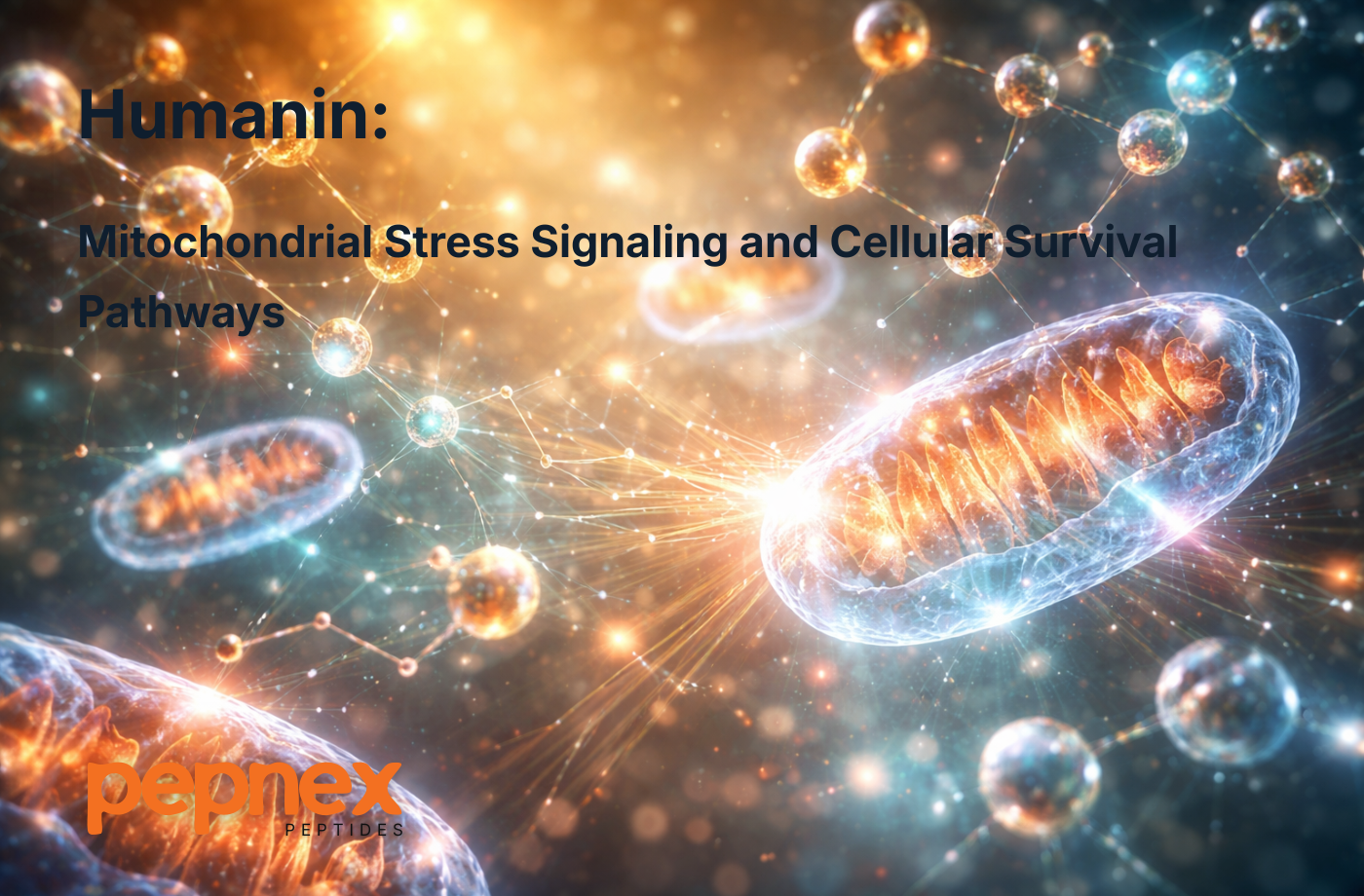
Humanin is a mitochondrial-derived peptide (MDP) originally identified through studies of cellular stress and neurodegeneration models. Within peptide research, Humanin is studied as a signaling molecule involved in mitochondrial communication, cellular stress resilience, and survival pathway modulation under experimental conditions.
Unlike many peptides translated from nuclear DNA, Humanin is encoded within the mitochondrial genome, placing it within a unique class of peptides that participate in mitochondrial–nuclear cross-talk. This characteristic has made Humanin a focal point in research examining how mitochondria actively influence cellular fate beyond energy production.
For a foundational overview of peptide signaling principles in research contexts, see
Peptides in Biomedical Research
https://pepnex.com/research-peptides-biomedical-research/
This article examines Humanin strictly as a preclinical research compound, focusing on its molecular origin, signaling mechanisms, and relevance in experimental metabolism and aging models.
Mitochondrial Origin and Discovery
Humanin was first identified during investigations into cellular survival pathways in stressed neuronal models. Subsequent research revealed that Humanin is encoded within mitochondrial DNA, distinguishing it from classical peptides synthesized via nuclear gene expression.
Key characteristics include:
- Mitochondrial genomic origin
- Short peptide sequence
- Presence across multiple tissue types in experimental models
This discovery contributed to the broader recognition of mitochondrial-derived peptides as active participants in intracellular signaling, rather than passive metabolic by-products.
Cellular Stress and Survival Signaling
A primary focus of Humanin research is its role in cellular stress response modulation. Experimental studies have investigated Humanin in models involving oxidative stress, metabolic strain, and mitochondrial dysfunction.
Research contexts include examination of:
- Anti-apoptotic signaling pathways
- Cellular resilience under metabolic stress
- Interaction with stress-responsive proteins
Rather than acting as a growth factor, Humanin appears to function as a protective signaling peptide, influencing how cells respond to adverse conditions at a molecular level.
Interaction with Apoptosis-Related Pathways
Humanin has been studied for its interaction with signaling molecules involved in programmed cell death. In experimental models, Humanin has been associated with modulation of pathways linked to:
- Mitochondrial integrity
- Stress-induced apoptosis signaling
- Cellular survival checkpoints
These studies are mechanistic and focus on signal modulation, not prevention of cell death in physiological systems.
Metabolic and Mitochondrial Research Context
Humanin research often overlaps with studies of metabolic adaptation and mitochondrial signaling, placing it alongside other mitochondrial-focused peptides such as MOTS-c
https://pepnex.com/research-mots-c/
While MOTS-c is primarily studied for its role in energy sensing and metabolic gene regulation, Humanin research emphasizes cell survival signaling and stress resistance, highlighting complementary roles within mitochondrial biology.
Aging-Related Research Models
Because mitochondrial dysfunction and cellular stress accumulation are central themes in aging biology, Humanin has been examined in experimental aging models.
Research investigations explore Humanin’s relationship to:
- Cellular lifespan markers
- Accumulated oxidative stress
- Long-term mitochondrial signaling stability
These studies focus on molecular aging pathways, not organism-level aging outcomes.
Distinction from Other Metabolism and Aging Peptides
Within peptide research, Humanin occupies a distinct position compared to other metabolism- or aging-focused peptides:
- Humanin: mitochondrial stress signaling and survival modulation
- MOTS-c: metabolic adaptation and energy sensing
- Epitalon: telomerase and chromatin-level aging pathways
https://pepnex.com/research-epitalon/
This distinction reinforces Humanin’s classification as a mitochondrial survival signaling peptide, rather than a metabolic regulator or telomere-focused compound.
Experimental Constraints and Interpretation
As with all mitochondrial signaling research, Humanin studies face important limitations:
- Effects are highly context-dependent
- Mitochondrial signaling varies across tissues
- In vitro stress models do not replicate systemic aging
Accordingly, Humanin should be understood strictly as a research tool for studying cellular stress and mitochondrial communication, not as a predictor of physiological or aging outcomes.
Research Classification and Context
Within the UK and EU, Humanin is classified strictly as a research compound. Its use is limited to:
- In-vitro experimentation
- Laboratory research
- Preclinical investigative models
It is not approved for human or animal use, and all findings remain within a research-only framework.
Conclusion
Humanin represents a foundational mitochondrial-derived peptide used to investigate cellular stress resilience, survival signaling, and mitochondrial communication at a molecular level. Its unique genomic origin and signaling profile make it a valuable research tool for exploring how cells respond to metabolic and oxidative challenges.
As interest in mitochondrial signaling continues to grow, Humanin remains central to research examining the non-energetic roles of mitochondria in cellular regulation.
Research Use Disclaimer
All content provided on this website is for informational and educational purposes only. Compounds discussed are supplied strictly for laboratory and in-vitro research use. They are not medicines, have not been approved by the MHRA, and are not intended for human or animal use. Nothing on this site constitutes medical advice.