Selank in Peptide Research: Neuroimmune Signaling and Stress-Response Modulation in Experimental Models
Introduction
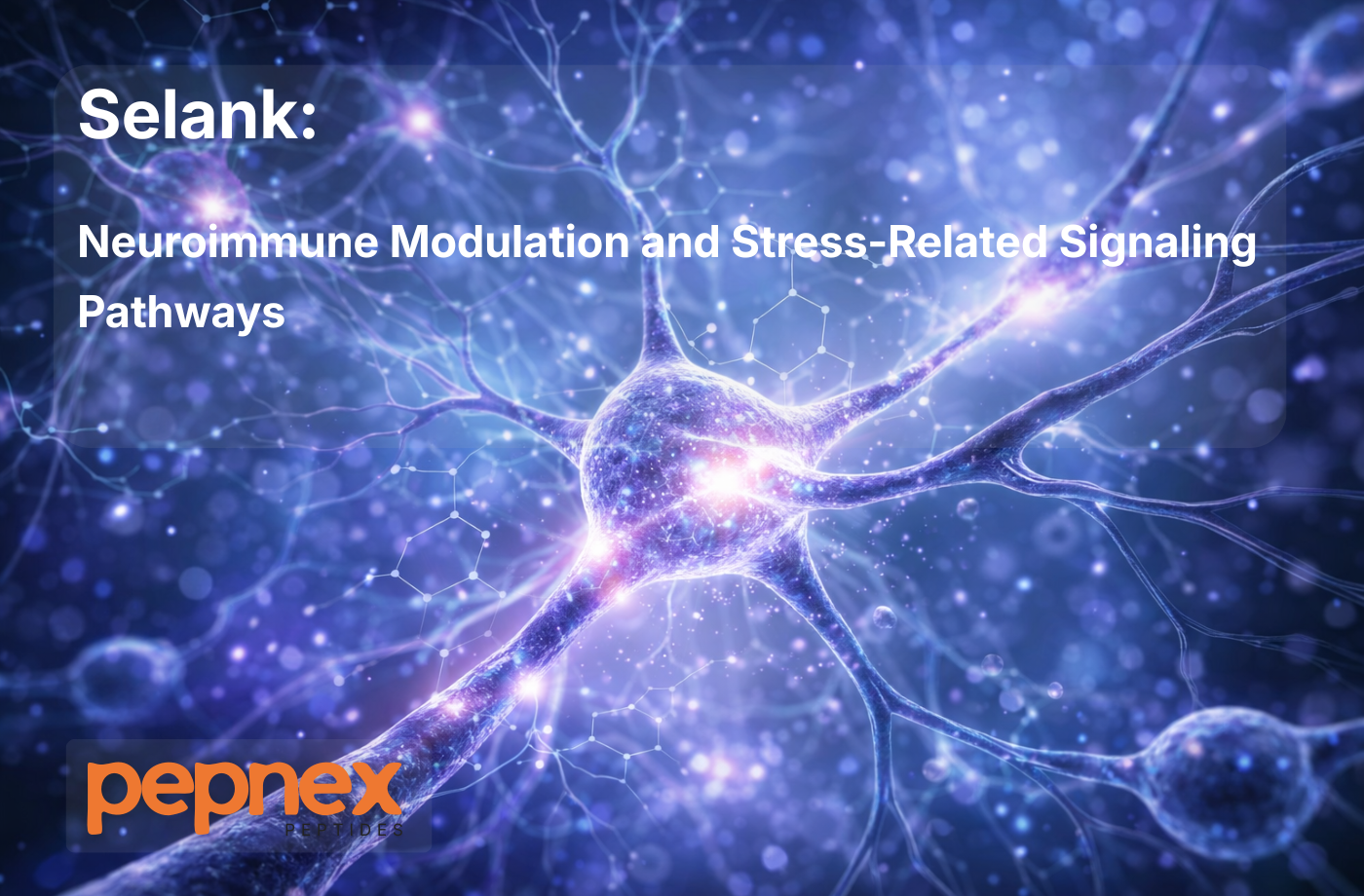
Selank is a synthetic heptapeptide derived from the endogenous immunomodulatory peptide tuftsin. Within peptide research, Selank is studied primarily for its role in neuroimmune interaction, stress-response signaling, and regulatory balance between neural and immune systems.
Unlike neuropeptides focused on structural plasticity or transcriptional regulation alone, Selank occupies a distinct research niche at the intersection of central nervous system signaling and immune modulation. This dual relevance has made Selank a useful experimental tool for studying how short peptides influence stress-related pathways, cytokine signaling, and neurotransmitter balance under controlled laboratory conditions.
This article examines Selank strictly as a preclinical research compound, focusing on its molecular origin, proposed mechanisms, and relevance within experimental neurobiology and immunology models.
Molecular Origin and Structural Characteristics
Selank is a synthetic analogue of tuftsin, a naturally occurring tetrapeptide fragment derived from immunoglobulin G (IgG). Tuftsin itself is involved in immune regulation, particularly in phagocytic activity.
Selank was engineered to:
- Extend peptide length for increased stability
- Reduce rapid enzymatic degradation
- Enhance consistency in experimental models
Key structural characteristics include:
- Short heptapeptide sequence
- Lack of endocrine or hormonal activity
- Enhanced resistance to peptidase breakdown in laboratory settings
These properties make Selank suitable for studying neuroimmune signaling without systemic hormonal interference.
Neuroimmune Signaling in Research Models
A central focus of Selank research is neuroimmune crosstalk—the bidirectional communication between neural signaling systems and immune pathways.
Experimental studies have investigated Selank’s influence on:
- Cytokine signaling balance
- Immune-related gene expression in neural tissue
- Interaction between stress pathways and immune response markers
Rather than acting as an immune stimulant or suppressant, Selank appears to function as a modulatory signal, helping researchers explore how balance is maintained between neural and immune systems under stress conditions.
Stress-Response Pathways and Regulatory Balance
Stress-response signaling involves tightly coordinated interactions between neurotransmitters, immune mediators, and intracellular signaling cascades. Selank has been studied in this context as a tool for examining how peptides influence adaptive stress signaling.
Research models have explored Selank’s relationship to:
- GABAergic signaling balance
- Stress-related neurotransmitter regulation
- Adaptive cellular responses to experimental stressors
Importantly, these investigations focus on molecular and signaling changes, not behavioral or physiological outcomes.
GABA-Related Research Context
Some Selank research explores its interaction with GABAergic signaling systems, which play a central role in neural inhibitory balance.
In vitro and preclinical studies have examined Selank’s potential influence on:
- GABA receptor expression
- Neurotransmitter equilibrium under stress conditions
- Regulatory signaling associated with inhibitory pathways
From a research perspective, Selank provides a model for studying non-direct receptor modulation, where peptide signaling influences system balance indirectly rather than acting as a classic agonist or antagonist.
Anti-Inflammatory Signaling Research
Selank has also been investigated in experimental models focused on inflammatory signaling regulation, particularly where neural and immune responses intersect.
Research observations include modulation of:
- Pro-inflammatory cytokine expression
- Immune-related transcriptional activity
- Stress-linked inflammatory signaling pathways
These findings position Selank as a useful research compound for examining inflammation regulation at the neuroimmune interface, without direct immune activation.
Distinction from Other Neuro-Focused Peptides
Within peptide research, Selank is often discussed alongside Semax and Dihexa, though their primary mechanisms differ:
- Selank: neuroimmune modulation, stress-response signaling
- Semax: transcriptional regulation, neurotrophic gene expression
- Dihexa: structural neuroplasticity, synaptogenesis
This distinction reinforces Selank’s classification as a regulatory and balancing peptide within experimental neuroscience.
For broader peptide context, see:
Peptides in Biomedical Researchhttps://pepnex.com/research-peptides-biomedical-research/
Experimental Constraints and Interpretation
As with all peptide-based research, Selank studies are subject to important limitations:
- Effects are context-dependent and model-specific
- Immune signaling outcomes vary across cell types
- Molecular modulation does not imply functional equivalence
Accordingly, Selank should be understood strictly as a mechanistic research tool, not a predictive or translational agent.
Research Classification and Context
Within the UK and EU, Selank is classified strictly as a research compound. Its use is limited to:
- In-vitro experimentation
- Laboratory research
- Preclinical investigative models
It is not approved for human or animal use, and all findings remain within a research-only framework.
Conclusion
Selank represents a distinct and valuable class of research peptide focused on neuroimmune interaction and stress-response modulation. By influencing regulatory signaling rather than structural or receptor-driven pathways, Selank enables researchers to explore how balance is maintained between neural and immune systems at a molecular level.
Its continued use in preclinical research contributes to a deeper understanding of peptide-mediated regulation across interconnected biological systems.
Research Use Disclaimer
All content provided on this website is for informational and educational purposes only. Compounds discussed are supplied strictly for laboratory and in-vitro research use. They are not medicines, have not been approved by the MHRA, and are not intended for human or animal use. Nothing on this site constitutes medical advice.